
Welcome · Your first step
Start with one real engineering problem.
Build a working practice for AI-assisted engineering, one chapter and one useful exercise at a time.
Our vision
Celebrate code generation.
FromAn engineering organization that celebrates code writing.
ToAn engineering organization that celebrates code generation.
The shift changes where engineers spend their attention: agreeing intent, writing a specification, guiding generation, and inspecting the result. People continue to own product decisions, quality, understanding, and the release.
Ravi Singh
The practice you are building
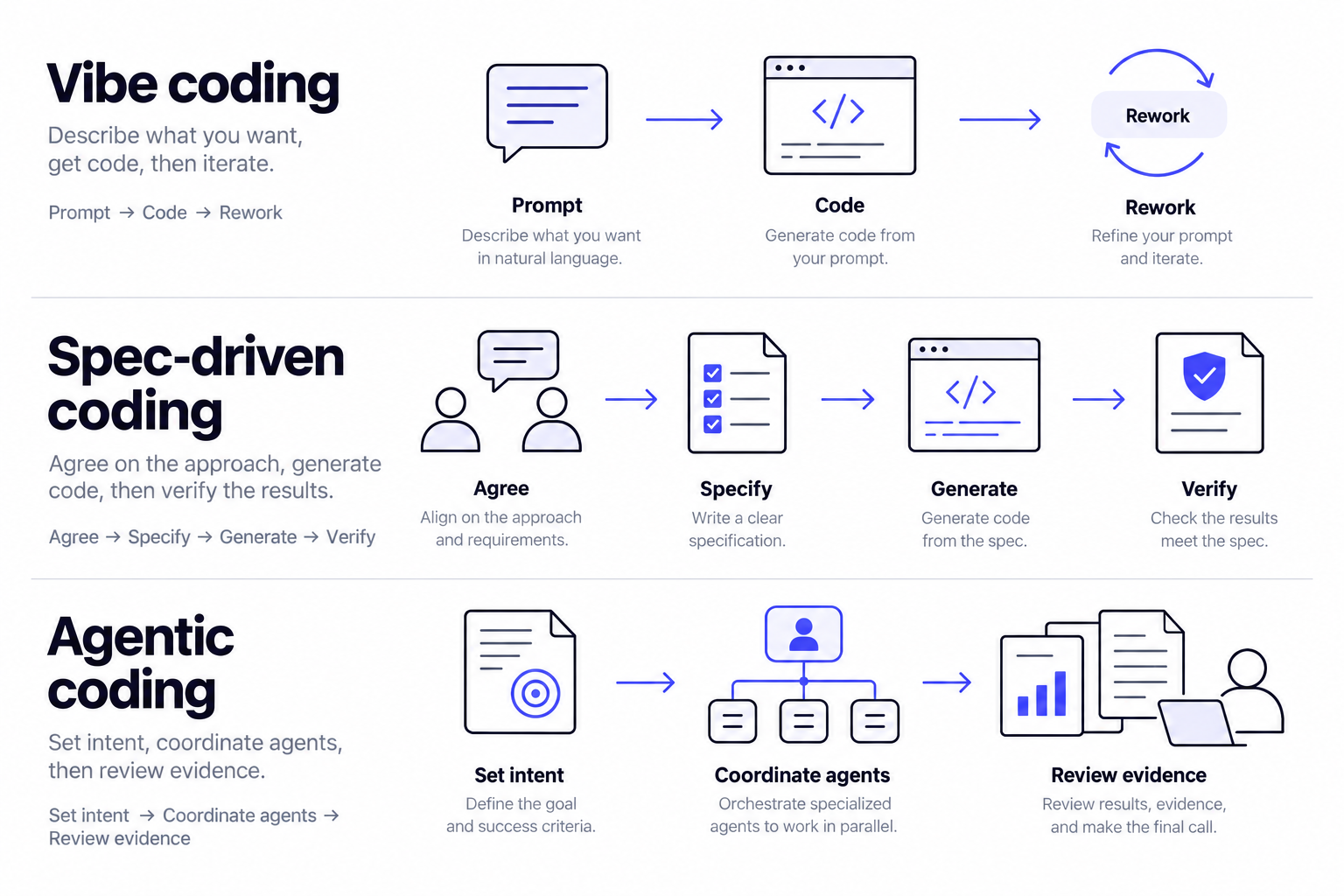
- Vibe coding
- Prompt → Code → Rework. The engineer steers each small step.
- Spec-driven coding
- Agree → Specify → Generate → Verify. A pair works from shared, testable intent.
- Agentic coding
- Set intent → Coordinate agents → Review evidence. People define the outcome, boundaries, and acceptance conditions.
This program builds the specification and verification habits that make the later practice possible. Keep changes bounded and increase autonomy only when the team can demonstrate its controls.
The work you will learn to do
Take a real ticket, agree on its intent, generate a bounded change, validate it, explain its behavior, and help another team use the method. Your charter, specification, checks, investigation notes, and playbook become a connected record of learning.
Keep one representative ticket with you through the chapters where practical. Add another when you need to test whether the practice transfers.
Bring the people who own the work
Start with two engineers and named product and quality partners. A sponsor protects working time and resolves obstacles. The coach teaches the workflow and reviews artifacts; engineering owners retain technical and release responsibility.
The coached starting model uses two pilot pods. Agree shared roles, protected time, and support with the program lead before kickoff. If you are exploring alone, use this exercise to prepare a conversation with your team; later exercises need a partner or receiving pod.
Agree the pilot pod roles and working rhythm in Phase 0 — Prepare.
First exercise
Write your starting note
Take a short working session with your team. Answer these five prompts in your own working document:
- Our friction: What slows or complicates a real task today?
- Our work: Which representative ticket could help investigate it?
- Our people: Who can pair, resolve product and quality questions, and sponsor the work?
- Our evidence: What could show improvement while quality holds?
- Our concern: What needs resolving before we start?
An honest gap is more useful than a guessed answer. Keep internal work and repository links in your team’s authorized workspace.
What a starting note could look like
“Administration tickets often need revisions because behavior decisions arrive late. We could begin with a workspace-invitation ticket. Two engineers can pair with product and quality partners. We can examine review revisions and acceptance timestamps, while accounting for ticket complexity. We still need approved tool access and protected time.”
How success feels
“We have a useful problem to explore and know who needs to be involved.”
Look for a named problem, representative work, and people who can resolve decisions. Feeling confident is optional; making the starting point explicit is the useful result.
If the problem feels too broad
Choose one recent ticket where review, rework, unclear requirements, or missing context created friction. Describe what happened before choosing a tool or making a performance promise. A coach can help narrow the exercise.
Your next action
Bring the starting note to your coached kickoff, or use it while working through Prepare. Missing access or baseline data becomes an explicit preparation task.